

Written by Tom Venning
tomvenning@outlook.com
These notes were adapted from the book “Market-Led Strategic Change”by Nigel F. Piercy, 2002, Butterworth-Heinemann (First published 1991 HarperCollins Publisher).

The difference between client satisfaction and loyalty is the difference between belief and behaviour. Satisfied clients believe they are getting value, loyal clients stay with one seller and their behaviour is predictable. A loyal client may not be satisfied; a satisfied client may not be loyal. The connection between the two is explained below
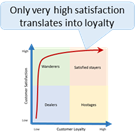
Low satisfaction and low loyalty – Dealers are people who normally buy junk. They spend as little as possible on low quality products, are dissatisfied so repeat the process… and are still unhappy. Unless you run a ‘pile-em high, sell-em cheap’ discount store you probably do not want clients who exhibit these characteristics, unless you can re-educate them and change their purchasing habits.
A second group of customers who appear in this quadrant are new customers who have no experience with your product or service. Consequently, they may have high expectations, but have no experience to be satisfied or loyal with. Your role is to manage their experience.
High satisfaction and low loyalty – Wanderers are people who see little differentiation between products and services. They are happy with what they buy, but this does not lead to brand loyalty. For example… think of note book computers. With the exception of Apple, there is little difference between most other brands, so it is difficult to create brand loyalty.
High loyalty and low satisfaction – Hostages … like the name suggestions, clients are normally locked into these relationships by tight contracts, high switching costs or lack of choice. For example… a typical telephone contract binds the user to a fixed time frame, and has penalties if you leave. If this is connected to online data storage, then leaving the provider means shifting your data to the new provider which is difficult. Finally… is there a difference between providers? Does it make a difference to switch?
High Loyalty and high satisfaction – Satisfied stayers believe that they are getting the best. They are happy and loyal. This is the ideal client – seller relationship. In the extreme top right corner, the maximum satisfaction and loyalty, clients become advocates. They recommend the seller, the product or service to their friends… this is seller paradise.
When does satisfaction translate into loyalty? As long as clients have choice, only extremely high satisfaction translates into loyalty. Clients will become advocates only when satisfaction is very high.
Imagine investigating a crime… a house break-in. There are clues; fingerprints, footprints, a broken window. The clues help you build a picture of what happened. It’s the same with planning a client journey. Look for the clues of what makes your client happy, and what keeps them coming back for more.
To build your client-seller relationship you need to understand what keeps the client satisfied and loyal, and you need to understand the relationship’s pain points. To do that follow this flow…
1. Choose which relationship you are interested in understanding. That could be; Client – you, client – your company, client – your department, client-competitor, and / or the client’s the ideal view.
2. List all the factors that affect the client relationship. The more information the better. Use your professional judgement about how deep to go. What you list depends on the client, their business, your existing relationship and how much you know about them.
The factors that affect satisfaction and loyalty have been built over time and tell us about the history of the relationship and its present condition. The following table shows some factors you may want to consider…
| Factors created by the client | Factors created by your company |
| Business approach Budget Their customer’s demographics Level of innovation Skills and capabilities Business targets Purchasing criteria Local laws Personal motivation Who makes the purchasing decision Intangibles i.e. feelings, trust, etc | Services you offer Terms and conditions of business Service levels Skills and capabilities Method of selling Local laws Quality Types of offerings Size of portfolio Intangibles |
3. Throughout this process keep a note of what you don’t know… a list of questions you need to clarify. One of the most powerful aspects of any planning activity is when you discover gaps in your knowledge. Closing these gaps is part of your action plan.
4. Some items in the list will be complex issues that you can break into detail. For example, the client may be loyal to your services (education, information delivery, Q&A hotline). It is more useful to break the Service relationship into its individual components (i.e. Response time, knowledge, invoicing speed, flexibility when things go wrong etc.) Understanding the details will give you the choice of which topics you need to address… here’s a second example… You may offer a telephone helpline service which covers several different product lines, and has different support levels. The customer may be happy with one product’s support and unhappy with another. If you don’t realise that you can’t learn from the strong service, and improve the poor service. So, split the service into its individual elements.
5. Position these factors in the different quadrants of the grid. Use different colours to signify the client-competitor, client-you / your company, your client’s ideal world. While positioning be aware of the criteria you use to measure satisfaction and loyalty. Are these your client’s criteria? Do you fully understand your client’s criteria? This is not a scientific activity… do it quickly… it will give you an overview of the what makes relationships valuable… you will need to double check with your client.
6. You now have a view of the relationship’s strengths and weaknesses and the points where you can intervene with minimum effort and maximum impact. These points are where there is a large gap between; your competitors offering and yours, and between the client’s current view and their ideal view.
You now need to decide which specific items on the grid you want to change. Consider the following…
High Loyalty and high satisfaction – Satisfied stayers
Typically, you want your client-seller relationships in the Satisfied Stayer quadrant. This is where you have long-term stable relationships, you are safe from competition and have the easiest sales. It is critical to understand why products, services and actions are in this quadrant. This is your target for all client interactions. Your goal is to try and move all relationships into this quadrant.

Typically, you want your client-seller relationships in the Satisfied Stayer quadrant. This is where you have long-term stable relationships, you are safe from competition and have the easiest sales. It is critical to understand why products, services and actions are in this quadrant. This is your target for all client interactions. Your goal is to try and move all relationships into this quadrant.
High satisfaction and low loyalty – Wanderers
Work here! Understand why the client is happy… this shows what they see as valuable. Discover why they are not loyal and ask what you can do to increase loyalty. Find ways of differentiating from competition by; helping the client understand what’s different, focus on the brand experience, build stronger personal relationships and speak to other LOBs to build a stronger value proposition.

Attack your client-competitor relationships with the same approach. Here it is possible to have short-term easy wins due to lack of differentiation. Often price, or the latest feature will make the difference. However, once you have successfully switched the client, you need to focus on adding value to the relationship to build loyalty. If you don’t, then your competition will attack back, probably with discount, and before you know it… you are in a price war.
High loyalty and low satisfaction – Hostages
Its easy selling to hostages … they have no choice. However as soon as choice arrives your clients will have their revenge! Secondly, if part of your relationship is based on holding hostages, this will negatively impact other aspects of the relationship… the client may feel cheated and distrustful as a hostage and carry this emotion into healthy parts of the relationship. So do what you can to help the client understand the value of the relationship, explain why lock-in exists, and focus on satisfaction in all areas of the relationship.
If your competitor uses hostage taking tactics then attack! You may need to wait till end of contract, or help reduce the pain of switching. You may need to help the client escape from old equipment, arrange buy backs, legal help etc. The key is to understand the client’s pain, and cure it creatively. It may take time, so you will need to build relationships and trust. Often the client may be resigned to their fate, and not understand that it is possible to escape… you need to help them understand what is possible and reduce risk (both business and personal) of switching.
Low satisfaction and low loyalty – Dealers
Do you want clients in this segment? You may want to lose these clients (give them to competition) as they create problems, complain, are negative advocates and always want a discount. However, their behaviour may result from years of poor service, and heavy discounts which have conditioned them into a specific purchasing habit. You can change this habit over time by educating the client about new ways of behaving and the stronger, long-term value proposition. Clients may appear in this quadrant because they are getting terrible service and don’t know what is possible. In this case find out what causes pain, and begin to change it.
Consider the following…
Actions. What do you need to do to change the situation? The client’s perception of your offering could be formed by a misunderstanding, in which case you need to correct it with better information. A change could happen by changing your behaviour, or managing your company more effectively. It could be that you are weak in a specific area, in which case you need to balance it with strengths in other areas. Maybe you want to highlight and build on strengths to transform them into loyalty drivers.
Who is effected by poor service? Is it only the client or people in the client’s network? You may need to address the issue with many different people to change the client’s experience. Also consider who suffers as a secondary effect. For example, an invoicing problem may effect the purchasing department which has the knock-on effect of additional paperwork for accounting, and questions rolling back to a project manager. You need to address the issue with everyone involved… because it’s the project manager who complains to the Key Decision Leader… who is your client.
The beauty of this model is that you don’t need to use it! It is a way of thinking, questioning, acting and strategizing.
Make a habit of asking your client several Satisfaction / loyalty questions in every meeting. You do this to…
Periodically go through the formal process of constructing the grid… this tests your reality (do you really know your client that well? Have you covered all points?) and it highlights gaps in your knowledge.
If your client is friendly and curious you may want to show them the complete grid to get feedback, or use an empty grid to run a discussion.
At regular intervals (every 4 to 6 months) meet your client to do a ‘Health Check’ meeting. This meeting will help you…
I recommend following the process outlined in “how to develop and fill the grid” above. That is
 Suomi
Suomi  English